Optics, Sensors and AI: Synergic Computational Imaging to Go Beyond the Limits Imposed by Conventional Imaging
Speaker
Department of Electrical and Computer Engineering, Rice University, USA
Hosts
Abstract
In this talk, I will discuss several projects in my lab at the confluence of optics, sensors and artificial intelligence. In particular, I will provide examples of how co-designing sensors, optics and AI algorithms results in superior performance capabilities for imaging systems. I will provide a few example projects: (1) how co-designing imaging optics along with AI algorithms can enable high-throughput 3D imaging, and microscopy, (2) how novel diffractive and meta-optical elements allow us to realize imaging systems with novel functionalities and form-factors and finally time-permitting, (3) how emerging neural representations along with high resolution spatial light modulators can allow us to image through thick scattering media without the need for guide-stars. I will use these projects to argue that we should look at the three computational blocks within an imaging system, optics, sensors and algorithms together and that co-designing them can result in significant performance improvements over the state of art.
About the Speaker
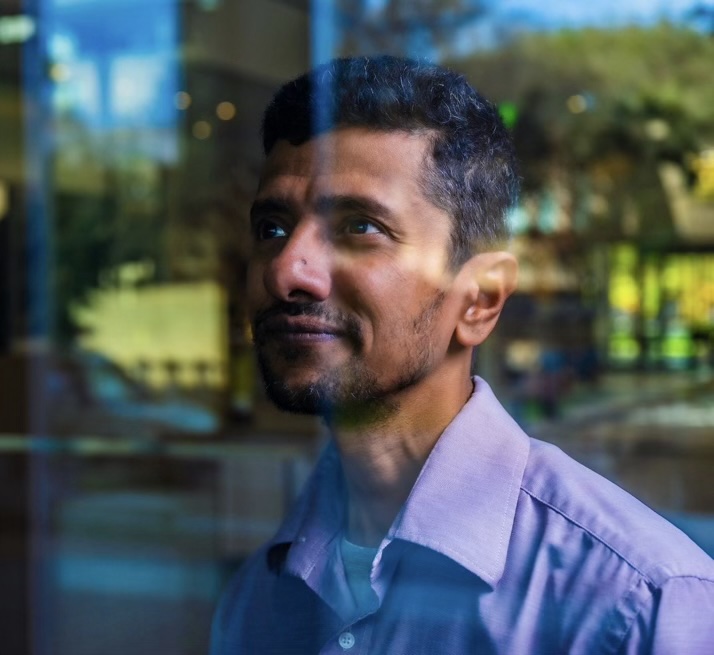
Ashok Veeraraghavan currently serves as the Chair of the Department of Electrical and Computer Engineering at Rice University. He also directs the Computational Imaging Lab, which focuses on solving hard and challenging problems in imaging and vision by co-designing sensors, optics, electronics, signal processing, and machine learning algorithms. Before joining Rice University, he spent three years as a Research Scientist at Mitsubishi Electric Research Labs in Cambridge, MA. He received his B.Tech. in Electrical Engineering from the Indian Institute of Technology, Madras in 2002, and M.S. and Ph.D. degrees from the Department of Electrical and Computer Engineering at the University of Maryland, College Park in 2004 and 2008 respectively. His thesis received the Doctoral Dissertation Award from the Department of Electrical and Computer Engineering at the University of Maryland. His work has won numerous awards including the Peter and Edith O’Donnell Award for Engineering in 2024, Charles Duncan Innovation Award 2019, Hershel M. Rich Invention Award in 2016 and 2017, and an NSF CAREER award in 2017.